
June Read: Under the Udala Trees
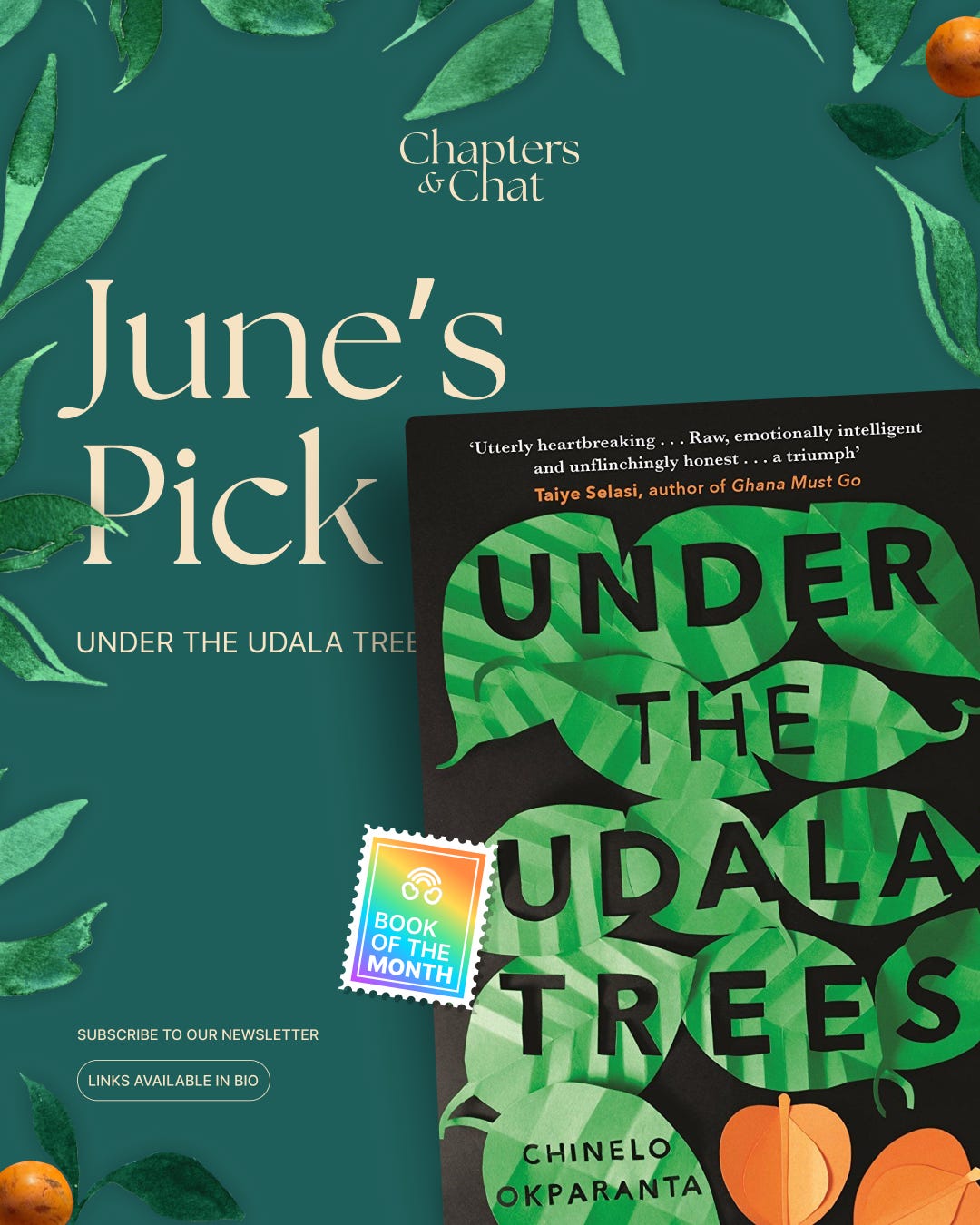
This month we’re reading Under the Udala Trees; a queer love story set during the civil War. It is one of the most honest depictions of what it costs to be visible when visibility itself is dangerous.

A lot of conversations about identity begin with the assumption that visibility is a universal good.
Be visible. Be yourself. Live openly.
The logic makes sense. If hiding parts of yourself is painful, then being seen must be freedom. But that idea depends heavily on where you’re standing.
Visibility is expensive. And the price is not evenly distributed.
For some people, being seen costs very little. For others, it costs relationships, community, employment, safety, housing, family, or belonging. The same act that is celebrated as authenticity in one context can become a liability in another.
That tension is what drew us to this month’s read.
THIS MONTH’S READ
Under the Udala Trees by Chinelo Okparanta follows Ijeoma, a young girl displaced by war who falls in love with Amina, another girl sheltering in the same home. It’s a love story, but also a story about the conditions that determine whether love is allowed to exist at all—what happens when desire collides with religion, family, community, and the practical realities of survival.
The novel is set during a war. In that kind of world, you don’t announce yourself lightly. War teaches people how to manage risk—when to speak, when to stay silent, when to draw attention to themselves, and when to disappear. Visibility is never neutral there.
And that feeling extends far beyond wartime.
We tend to admire visibility because we encounter it after the fact. We see the person who spoke up, came out, stood firm. What we rarely see are the conditions that made those choices possible: supportive families, financial independence, legal protections, communities willing to catch them if they fall.
Not everyone has those things.
In Nigeria, where the novel is set, queerness exists within a specific social reality. For many people, silence isn’t simply shame or fear. It can be a rational response to real conditions—a way of navigating a world that is not built to hold certain truths safely.
That’s what I keep coming back to.
Do our conversations about visibility overlook the reality of risk?
Do we sometimes mistake caution for cowardice, or privacy for shame?
Perhaps visibility isn’t just a measure of courage, but also a negotiation between truth and consequence.
As I read Under the Udala Trees this month, that’s the question I’m carrying with me: not just what it means to be seen, but who can afford to be.
Until the next read,
Chapters & Chat